---
title: Toward Operational Excellence 4.0 – Revisited 2025
description: Companies must also recognize that interoperability is the key to better orchestration. A built-for-purpose solution that breaks down silos—enabled by a unified architecture—is essential.
image: https://blog.drivingoe.com/hubfs/oe4.0-fig1-social.webp
---
- [(713) 355-2900](tel:1-713-355-2900)
- [Contact Us](https://drivingoe.com/connect-with-os/contact-os/)
- [Customer Support](https://drivingoe.com/connect-with-os/customer-support/)
- [Talk to an Expert](https://drivingoe.com/connect-with-os/contact-os/)
- [Careers](https://drivingoe.com/about-os/careers/)
[](https://drivingoe.com/)
- About OS
- [The OS Difference](https://drivingoe.com/about-os/the-os-difference/)
- [Our People](https://drivingoe.com/about-os/our-people/)
- [Clients & Case Studies](https://drivingoe.com/about-os/clients-case-studies/)
- Focus Areas
- [Operational Excellence (OE)](https://drivingoe.com/focus-areas/operational-excellence/)
- [Enterprise Loss Prevention (ELP)](https://drivingoe.com/focus-areas/enterprise-loss-prevention/)
- [Enterprise Risk Management (ERM)](https://drivingoe.com/focus-areas/enterprise-risk-management/)
- [Asset Performance Management (APM)](https://drivingoe.com/focus-areas/asset-performance-management/)
- [Capital Projects](https://drivingoe.com/focus-areas/capital-projects/)
- [EHS Compliance](https://drivingoe.com/focus-areas/ehs-compliance/)
- [ESG](https://drivingoe.com/focus-areas/esg/)
- [Management of Change (MOC)](https://drivingoe.com/focus-areas/management-of-change/)
- [Mechanical Integrity](https://drivingoe.com/focus-areas/mechanical-integrity/)
- [Operations & Production](https://drivingoe.com/focus-areas/conduct-of-operations/)
- [Process Safety](https://drivingoe.com/focus-areas/process-safety/)
- [Process Safety Information (PSI)](https://drivingoe.com/focus-areas/process-safety-information/)
- [Quality Management](https://drivingoe.com/focus-areas/quality-management/)
- [Safety Lifecycle](https://drivingoe.com/focus-areas/safety-lifecycle/)
- [Workforce](https://drivingoe.com/focus-areas/connected-workforce/)
- Products & Services
- [OESuite® Software](https://drivingoe.com/products-services/oesuite/)
- [Frameworks & Solutions](https://drivingoe.com/products-services/oesuite/#gray_frameworks)
- [Implementation](https://drivingoe.com/products-services/oesuite/#implementation)
- [Software Connectors & Integrations](https://drivingoe.com/products-services/oesuite/list-of-connectors-with-oesuite/)
- [Mobile Applications](https://drivingoe.com/products-services/oesuite-mobile-applications/)
- [OESuite® Reviews](https://drivingoe.com/products-services/oesuite/oesuite-reviews/)
- [Services](https://drivingoe.com/products-services/oesuite/oesuite-services/)
- [Technical Content](https://drivingoe.com/products-services/technical-content/)
- [Value Engineering](https://drivingoe.com/products-services/value-engineering/)
- Resources
- [Brochures](https://drivingoe.com/resources/brochures/)
- [Case Studies](https://drivingoe.com/for-industry/case-studies/)
- [Testimonials & Reviews](https://drivingoe.com/resources/testimonials-and-reviews/)
- [Videos/Podcasts](https://drivingoe.com/resources/videos-podcasts/)
- [Webinars & Events](https://drivingoe.com/news-events/current-events/)
- [White Papers](https://drivingoe.com/resources/white-papers/)
- News/Events
- [Current Events](https://drivingoe.com/news-events/current-events/)
- [News & Articles](https://blog.drivingoe.com/)
- Connect with OS
- [Connect with Us](https://drivingoe.com/connect-with-os/connect-with-us/)
- [Customer Support](https://os.oesuite.com/HelpDeskApp)
- [Careers](https://drivingoe.com/about-os/careers/)
# Toward Operational Excellence 4.0 – Revisited 2025
December 23, 2025
**By Joe Perino, former LNS Research analyst**
Nearly five years ago, I wrote an article entitled *“Toward Operational Excellence 4.0 (OE 4.0).”* In it, I delved into the history of operational excellence—its various definitions, frameworks, and applications—while raising several questions about how it could be operationalized. I noted that OE 4.0 represented a shift away from safety and compliance toward comprehensive risk management, moving beyond Environmental, Health, and Safety (EHS) and Process Safety Management (PSM) compliance to a proactive, integrated operations management system.
I argued that merely connecting the silos of so-called best-of-breed software would not suffice, and that true integration was unlikely given the prevailing software architectures in use at the time. I suggested that the industry needed to move beyond software integration to achieve true business process integration—recognizing how one process impacts another as operating conditions change and risk evolves. I referred to this concept as *interoperability*: a single, unified architecture that unlocks interactions not possible when companies operate across multiple, siloed data architectures. Simply aggregating data from various silos into a layered analytics application can be helpful, but it still falls short, as it presents an as-is view without addressing or improving the underlying business processes.
I also observed that vendors across adjacent markets were competing for position, expanding into one another’s territory, and all claiming ownership of operational excellence and risk management. This made it difficult for operating companies to choose OE solutions and reduced their willingness to change, as many could not clearly see the path—or the expected return on investment—to a better outcome. As a result, the prevailing tendency was to do nothing or wait for the market to mature.
Compounding this issue, software initiatives were often driven by departmental needs, leading to fragmented vendor alignments even when common functions were shared (for example, mechanical integrity across PSM and inspection organizations). I viewed this as a missed opportunity for operating companies to proactively improve performance, particularly given the growing need for resilient operations. At the time, it was clear to me that there was a meaningful opportunity for innovation.
So, how has OE 4.0 progressed since then? Have we achieved business process integration and an integrated operations management system, or do we remain siloed, relying on competing and overlapping software solutions? Have we truly developed a firm understanding of operational risk—the portion of risk focused on operations and compliance—and clarified who owns it?
At the time, I noted that EHS software largely carried the risk, safety, and PSM mandate. However, EHS functionality tended to focus more on tracking and reporting than on proactive execution or predictive risk management. Most EHS vendors also lacked key PSM capabilities, including robust asset registries; mechanical and electrical integrity programs (time- and risk-based inspections); training and competency management; organizational change management; comprehensive document management; procedural automation focused on process safety information; and full safety lifecycle management beyond basic risk assessment.
Asset Performance Management (APM), by contrast, had embraced digital capabilities, leveraging artificial intelligence (AI) and machine learning (ML) to predict asset performance. At the time, I asked whether EHS would expand into APM—or perhaps merge with APM and quality.
The purpose of this article, therefore, is to assess the progress made since then, revisit those questions, and offer a refreshed path forward. To do so, I first revisit the definition of operational excellence, followed by a brief review of recent developments in the APM, EHS, PSM, Operations, Production, and Quality Management System (QMS) markets. I then outline a vision for moving forward.
The November 2020 article concluded with a definition of OE 4.0 centered on sustainable value creation through a holistic approach supported by an enabling execution platform. That definition remains valid today—if not more critical—given advances in technology (including AI/ML and digital twins) and the worsening talent shortage driven by baby boomer retirements and declining interest in manufacturing careers among younger generations. I argued then, and still believe, that what is needed is an integrated OE execution system that seamlessly connects the key OE activities, including:
1. **Strategy**
2. **Integrated processes that transcend departmental boundaries**, including:
a. Asset and Process Integrity
b. Quality
c. EHS
d. Process Safety Management
e. Operations and Production
f. Workforce Competency, Effectiveness, and Efficiency
3. **Performance Management**
4. **Operational Risk Management**
My vision for such a system was illustrated in Figure 1.
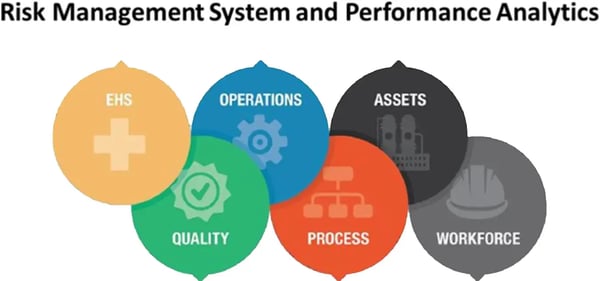
*Figure 1 - Proposed Operational Excellence Framework*
In 2020, there were only a handful of APM players, led by GE Digital—now GE Verona—which acquired Meridium in 2016 and remains a leader in the process industries. Most major automation vendors also developed their own APM offerings, with Emerson acquiring AspenTech and evolving its APM capabilities from two discrete products into a more comprehensive system. SAP and Oracle both claim positions in this space, while IFS has been building out its platform through acquisitions and partnerships.
The layered database-and-analytics approach has not disappeared. Snowflake and Databricks have both expanded significantly, each acquiring analytics capabilities. Could one build an OE framework on these platforms? Possibly. However, both lack the subject matter expertise required to drive workflows and support operational content. As a result, they remain more aligned with IT experimentation than with direct support of plant and factory-floor operations.
The EHS and QMS software markets have experienced significant growth since 2020. Many leading vendors now combine the two—and often PSM as well—through acquisitions and product extensions. As of 2025, Gartner tracks 44 EHS vendors and 63 QMS vendors. While this breadth provides options for companies of all sizes across industries, it is difficult to believe that further consolidation will not occur. In fact, it has already begun, as evidenced by Hexagon’s acquisition of EQT. Only a small number of larger vendors meaningfully serve the process industries.
Product capabilities have improved, with added features such as root cause analysis and AI-enabled analytics. However, despite continued claims of owning the risk management mandate, without the ability to execute integrity management and workforce performance, these solutions will, in my opinion, fall short of true operational risk management.
Another driver of OE adoption in the process industries is the desire to close the loop between planning, design, engineering, and construction—typically handled by EPCs—and the operate, maintain, and optimize phases managed by owner-operators. In advanced discrete industries such as automotive, aerospace, and semiconductors, this loop is already closed. Operating data continuously feeds back into design and product improvement. A familiar example is a car notifying a dealer to schedule maintenance based on operating conditions rather than mileage alone.
In the process industries, this remains a gap. Most EPCs lack downstream operations and maintenance businesses, leaving owner-operators to bridge the gap themselves—adding cost and time to capital investments.
*Figure 2 - ARC OADT Group Members*
Numerous initiatives are now exploring the use of digital twins to address this issue, including ARC Advisory Group’s Open Asset Digital Twin (OADT) Working Group. The premise is straightforward: if the digital twin created during design and engineering can be carried forward into operations and maintenance, the loop can be closed and used for ongoing monitoring and optimization. This suggests that operations and maintenance systems should be configured during design and engineering, rather than after—or at least not lagging significantly behind—handover to operations.
This is why I have long advocated for a truly integrated OE system—one in which strategy guides workflows and best practices; data is captured and analyzed across traditional silos; deviations from target performance are identified and explained; risks are surfaced; corrective actions are facilitated; and outcomes are translated into measurable economic benefits.
So, is there anyone capable of delivering on the full OE mission? To my knowledge, only one niche software company has attempted to comprehensively address the OE challenge: Houston-based **Operational Sustainability® (OS)**. Now in business for 15 years, its **OESuite®** enterprise software includes 38 integrated modules and supporting mobile applications that address most OE functions, including:
- Asset Management & APM
- Capital Projects & Portfolio Management
- EHS Compliance / ESG
- Management of Change (MOC)
- Integrity Management
- Operations Management & Production
- PSM
- Process Safety Information (PSI) & Engineering Content
- Quality Management
- Safety Lifecycle Management
- Connected Workforce
In addition, the company provides frameworks, solutions, and best practices designed to accelerate implementation, including ready-to-use processes, standards, policies, procedures, and field guides in areas such as MOC, Process Safety, Conduct of Operations, Safe Work Practices, and Mechanical Integrity. Their client base primarily consists of mid-to-upper-tier process industry companies, including Ineos, Monroe Energy, Enviva Biomass, Ashland Chemical, IGI Waxes/Silver Eagle, and Alpek Polyester USA.
Why mid-to-upper-tier companies? First, many lag behind the largest firms in deploying OE-related software. Second, many large organizations remain stuck in a state of inaction—still constrained by siloed structures and legacy technical debt. In some cases, OE itself is not well understood, making alignment on the need for change difficult. That said, this dynamic is beginning to shift.
One catalyst for this change is the **Operational Excellence Consortium (OEC)**, founded in 2024 by Operational Sustainability founder David Drerup. The OEC is a non-profit organization created to help industry upskill its workforce through training and mentoring; develop strategies for business excellence; provide access to self-assessment tools, technical content, and market research; and offer limited management consulting through a network of experts. It also provides feedback to academia to help shape curriculum development. The founding members are shown in Figure 3.
*Figure 3 - Operational Excellence Consortium Founding Members*
The OEC board includes:
- David Drerup, Founder & CEO, Operational Sustainability, LLC
- Dr. David Ma, Professor and Dean, Texas A&M University–Corpus Christi, College of Engineering and Computer Science
- Steve Beamer, 40+-year industry veteran
- Dr. Klaus M. Blache, Director, Reliability & Maintainability Center (RMC) and Professor, University of Tennessee
The board is supported by a group of experienced industry advisors and committee members.
The consortium’s initial efforts have focused on developing a revised OE framework and a self-assessment tool. Early work emphasizes helping companies establish a strong OE foundation that reduces overlap, accelerates learning, lowers overhead, and drives more consistent performance, as illustrated in Figure 4. Approximately 40 operating companies currently participate in the OEC.
**Integrated OE Management System**
**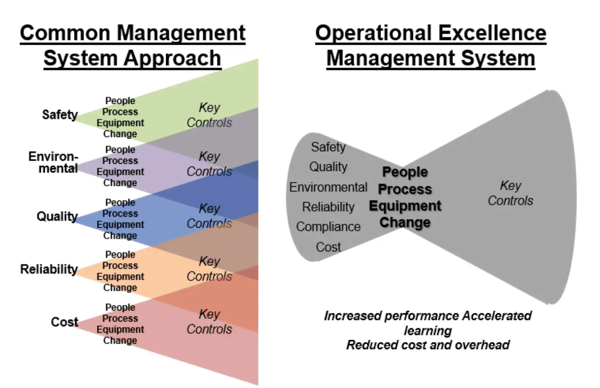**
*Figure 4- Operational Excellence Consortium Integrated Management System*
In addition, the OEC is working with operating companies to educate them on AI while piloting use cases aligned with core business objectives. The consortium represents a wake-up call for the industry to re-engage with operational excellence.
So, what should operating companies do?
They should pursue a single, unified architecture for OE—even if that requires re-platforming. A unified architecture simplifies reporting and enables seamless execution of end-to-end business processes across departmental boundaries.
Companies must also recognize that interoperability is the key to better orchestration. A built-for-purpose solution that breaks down silos—enabled by a unified architecture—is essential. Larger organizations often rely on a wide array of functionally excellent point solutions; however, platforms that span multiple OE domains (EHS, APM, operations) are better positioned to deliver integrated value.
Such change is not painless. But without pain, there is no gain. The good news is that companies can pursue a phased transition—introducing modules incrementally, guided by strategy and along a path that aligns with their readiness and objectives.
For more information on the OESuite®, visit [https://drivingoe.com](https://drivingoe.com).
For more information on the OEC, visit [https://my-opex.org](https://my-opex.org).
« [Previous](https://blog.drivingoe.com/key-components-of-operational-discipline)
[Back to News & Articles](https://blog.drivingoe.com)
[Next](https://blog.drivingoe.com/artificial-intelligence-ai-enterprise-loss-prevention-elp-drive-deeper-insights-reduce-value-leakage) »
### Topics of Interest
- [Asset Strategy / Asset Performance Management (9)](https://blog.drivingoe.com/tag/asset-performance-management)
- [Compliance Management (5)](https://blog.drivingoe.com/tag/compliance-management)
- [Conduct of Operations (15)](https://blog.drivingoe.com/tag/conduct-of-operations)
- [Cultural Safety (4)](https://blog.drivingoe.com/tag/cultural-safety)
- [EHS / Sustainability (3)](https://blog.drivingoe.com/tag/ehs-sustainability)
- [Enterprise Loss Prevention (9)](https://blog.drivingoe.com/tag/enterprise-loss-prevention)
- [Management of Change (8)](https://blog.drivingoe.com/tag/moc)
- [Mechanical Integrity (3)](https://blog.drivingoe.com/tag/mechanical-integrity)
- [Mobile Applications (5)](https://blog.drivingoe.com/tag/mobile-applications)
- [Operational Excellence (14)](https://blog.drivingoe.com/tag/operational-excellence)
- [Operational Readiness (10)](https://blog.drivingoe.com/tag/operational-readiness)
- [Operational Risk Management (18)](https://blog.drivingoe.com/tag/operational-risk-management)
- [Organizational Performance (11)](https://blog.drivingoe.com/tag/organizational-performance)
- [Press Releases (7)](https://blog.drivingoe.com/tag/press-releases)
- [Process Safety / RMP (23)](https://blog.drivingoe.com/tag/process-safety-rmp)
- [Production / Value (4)](https://blog.drivingoe.com/tag/production-value)
- [Workforce Competency / Connected Workforce (11)](https://blog.drivingoe.com/tag/workforce-competency-connected-workforce)
Operational Sustainability, LLC
16225 Park Ten Place Drive
Suite 800
Houston, TX 77084
Phone: [(713) 355-2900](tel:+1-713-355-2900)
[Contact Us](https://drivingoe.com/connect-with-os/contact-os/)

© 2025 Operational Sustainability, LLC. All rights reserved.
[Privacy Policy](https://drivingoe.com/privacy-policy) | [Terms of Use](https://drivingoe.com/terms-of-use)
```json
{
"@context" : "https://schema.org",
"@type" : "NewsArticle",
"author" : [ {
"@type" : "Person",
"name" : "Joe Perino",
"url" : "https://blog.drivingoe.com/author/joe-perino"
} ],
"dateModified" : "2025-12-23T20:50:32",
"datePublished" : "2025-12-23T20:47:30",
"headline" : "Toward Operational Excellence 4.0 – Revisited 2025",
"image" : [ "https://7432105.fs1.hubspotusercontent-na1.net/hubfs/7432105/oe4.0-fig1-social.webp" ]
}
```
```json
{
"@context" : "https://schema.org",
"@type" : "BlogPosting",
"author" : {
"@type" : "Person",
"name" : "Joe Perino",
"url" : "https://blog.drivingoe.com/author/joe-perino"
},
"dateModified" : "2025-12-23T20:50:32.715Z",
"datePublished" : "2025-12-23T20:47:30.000Z",
"headline" : "Toward Operational Excellence 4.0 – Revisited 2025",
"mainEntityOfPage" : {
"@id" : "https://blog.drivingoe.com/toward-operational-excellence-4.0-revisited-2025",
"@type" : "WebPage"
},
"publisher" : {
"@type" : "Organization",
"logo" : {
"@type" : "ImageObject",
"url" : "https://blog.drivingoe.com/hubfs/OS-Stacked-300x300-1.png"
},
"name" : "Operational Sustainability, LLC®"
}
}
```