
Organizations strive for incident-free operations, which require a complex balance of compliance, solid engineering design, sound construction, operational integrity, appropriate asset maintenance, reliability programs, and trained, competent personnel.
Proactively identifying risks and vulnerabilities that lead to incidents and subsequent losses requires taking action to reduce or prevent their impact. At Operational Sustainability® (OS), we approach identifying and closing future gaps in management systems and human performance to achieve incident-free operations through an Enterprise Loss Prevention (ELP) framework—because managing risk to prevent loss is critical to achieving Operational Excellence (OE).
However, industry is constantly changing, and the need to determine the place of Artificial Intelligence (AI) in work practices to stay competitive is growing. During two separate industry conferences, 16 participants from the ammonia industry and 10 participants from gas processing shared their views regarding ELP work practices and initial thoughts around AI.
The following is a summary of questions we posed and the subsequent feedback, by industry.
Ammonia
Q1: Does your company have a formal risk management committee that addresses enterprise and operational risk as a foundation for ELP?
- Only 2 participants raised their hands.
Q2: How would you describe your organization’s current focus on Enterprise Loss Prevention (ELP)?
- 13% answered ‘primarily reactive (we investigate incidents – safety, quality, performance lags – after they occur)’
- 38% answered ‘Beginning to take proactive steps (some risk identification, limited prevention programs)’
- 31% answered ‘actively building structured loss prevention programs across functions (i.e., Production Loss Analysis has a formal structure)’
- 13% answered ‘well-established ELP programs, but with room for increased consistency and better integration (i.e., we have moved beyond spreadsheets for PLA)’
- 6% answered ‘highly proactive and integrated ELP practices across all operations (i.e., we are connecting with the data historian, linked into operations)’
Q3: Which of the following areas represents the biggest challenge for your organization in achieving incident-free (or operationally excellent) operations?
- 0% answered ‘compliance with regulations and standards’
- 0% answered ‘focus on reducing human error’
- 19% answered ‘workforce training and competency development’
- 31% answered ‘engineering design and construction quality’
- 13% answered ‘operational integrity and conduct of operations’
- 31% answered ‘asset maintenance and reliability programs’
- 6% answered ‘other (please specify)’ but didn’t provide additional information
While ELP hasn’t been formalized in the hydrocarbon processing and process industries for many reasons, the data indicates that organizations today operate in disjointed, siloed software primarily focused on incidents for EHS compliance, making it challenging to gain holistic insights into performance across all departments.
Q4: How prepared do you believe your organization is to leverage AI tools to improve Operational Excellence (OE) and ELP efforts?
- 19% answered ‘not prepared at all – AI isn’t currently on our radar’
- 13% answered ‘slightly prepared – initial conversations, but no action yet’
- 50% answered ‘moderately prepared – pilot projects or early adoption efforts underway’
- 13% answered ‘well prepared – AI is being integrated into some operational systems’
- 6% answered ‘highly prepared – AI is already an established part of our OE and safety strategy’
Gas Processing
Q1: Does your company have a formal risk management committee that addresses enterprise and operational risk as a foundation for ELP?
- Only 2 participants raised their hands.
Q2: How would you describe your organization’s current focus on Enterprise Loss Prevention (ELP)?
- 30% answered ‘primarily reactive (we investigate incidents – safety, quality, performance lags – after they occur)’
- 30% answered ‘Beginning to take proactive steps (some risk identification, limited prevention programs)’
- 30% answered ‘actively building structured loss prevention programs across functions (i.e., Production Loss Analysis has a formal structure)’
- 10% answered ‘well-established ELP programs, but with room for increased consistency and better integration (i.e., we have moved beyond spreadsheets for PLA)’
- 0% answered ‘highly proactive and integrated ELP practices across all operations (i.e., we are connecting with the data historian, linked into operations)’
Q3: Which of the following areas represents the biggest challenge for your organization in achieving incident-free (or operationally excellent) operations?
- 0% answered ‘asset maintenance and reliability programs’
- 10% answered ‘engineering design and construction quality’
- 10% answered ‘operational integrity and conduct of operations’
- 10% answered ‘focus on reducing human error’
- 30% answered ‘compliance with regulations and standards’
- 40% answered ‘workforce training and competency development’
- 0% answered ‘other (please specify)’
Q4: How prepared do you believe your organization is to leverage AI tools to improve Operational Excellence (OE) and ELP efforts?
- 20% answered ‘not prepared at all – AI isn’t currently on our radar’
- 20% answered ‘slightly prepared – initial conversations, but no action yet’
- 30% answered ‘moderately prepared – pilot projects or early adoption efforts underway’
- 20% answered ‘well prepared – AI is being integrated into some operational systems’
- 10% answered ‘highly prepared – AI is already an established part of our OE and safety strategy’
OS has observed that less than 20% of companies in the ammonia industry, and none in gas processing, have a formal structure that addresses ELP, and these results confirm that pattern. These observations also tell us that leadership frequently faces challenging decisions that impact safety, production, costs, and people, often without the benefit of a comprehensive framework to identify, prevent, and ultimately mitigate the risks associated with those decisions. In both cases, it appears that less than 10% of companies are highly prepared for artificial intelligence.
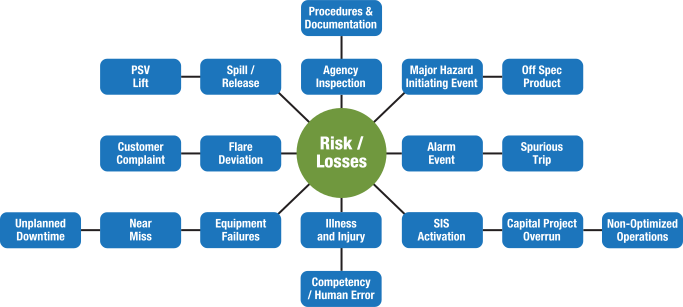
Figure 1 – OS Enterprise Loss Prevention Framework
Companies need more effective work processes and supporting governance structures (i.e., risk appetite statement, policies, standards, and procedures) to empower their leaders to make the right decisions. With the OESuite® enterprise software platform, organizations can leverage an interoperable software solution to organize, evaluate, and share ELP data seamlessly across key departments, creating a structured way to approach critical decisions and incorporate AI as it continues to mature.