---
title: "An Operational Excellence (OPEX) Strategy Requires an Enterprise Architecture: Part 3"
description: In Part 3, we’ll review potential solutions, their benefits and challenges, and the value of interoperability to achieve OE.
image: https://blog.drivingoe.com/hubfs/undefined-2.png
---
- [(713) 355-2900](tel:1-713-355-2900)
- [Contact Us](https://drivingoe.com/connect-with-os/contact-os/)
- [Customer Support](https://drivingoe.com/connect-with-os/customer-support/)
- [Talk to an Expert](https://drivingoe.com/connect-with-os/contact-os/)
- [Careers](https://drivingoe.com/about-os/careers/)
[](https://drivingoe.com/)
- About OS
- [The OS Difference](https://drivingoe.com/about-os/the-os-difference/)
- [Our People](https://drivingoe.com/about-os/our-people/)
- [Clients & Case Studies](https://drivingoe.com/about-os/clients-case-studies/)
- Focus Areas
- [Operational Excellence (OE)](https://drivingoe.com/focus-areas/operational-excellence/)
- [Enterprise Loss Prevention (ELP)](https://drivingoe.com/focus-areas/enterprise-loss-prevention/)
- [Enterprise Risk Management (ERM)](https://drivingoe.com/focus-areas/enterprise-risk-management/)
- [Asset Performance Management (APM)](https://drivingoe.com/focus-areas/asset-performance-management/)
- [Capital Projects](https://drivingoe.com/focus-areas/capital-projects/)
- [EHS Compliance](https://drivingoe.com/focus-areas/ehs-compliance/)
- [ESG](https://drivingoe.com/focus-areas/esg/)
- [Management of Change (MOC)](https://drivingoe.com/focus-areas/management-of-change/)
- [Mechanical Integrity](https://drivingoe.com/focus-areas/mechanical-integrity/)
- [Operations & Production](https://drivingoe.com/focus-areas/conduct-of-operations/)
- [Process Safety](https://drivingoe.com/focus-areas/process-safety/)
- [Process Safety Information (PSI)](https://drivingoe.com/focus-areas/process-safety-information/)
- [Quality Management](https://drivingoe.com/focus-areas/quality-management/)
- [Safety Lifecycle](https://drivingoe.com/focus-areas/safety-lifecycle/)
- [Workforce](https://drivingoe.com/focus-areas/connected-workforce/)
- Products & Services
- [OESuite® Software](https://drivingoe.com/products-services/oesuite/)
- [Frameworks & Solutions](https://drivingoe.com/products-services/oesuite/#gray_frameworks)
- [Implementation](https://drivingoe.com/products-services/oesuite/#implementation)
- [Software Connectors & Integrations](https://drivingoe.com/products-services/oesuite/list-of-connectors-with-oesuite/)
- [Mobile Applications](https://drivingoe.com/products-services/oesuite-mobile-applications/)
- [OESuite® Reviews](https://drivingoe.com/products-services/oesuite/oesuite-reviews/)
- [Services](https://drivingoe.com/products-services/oesuite/oesuite-services/)
- [Technical Content](https://drivingoe.com/products-services/technical-content/)
- [Value Engineering](https://drivingoe.com/products-services/value-engineering/)
- Resources
- [Brochures](https://drivingoe.com/resources/brochures/)
- [Case Studies](https://drivingoe.com/for-industry/case-studies/)
- [Testimonials & Reviews](https://drivingoe.com/resources/testimonials-and-reviews/)
- [Videos/Podcasts](https://drivingoe.com/resources/videos-podcasts/)
- [Webinars & Events](https://drivingoe.com/news-events/current-events/)
- [White Papers](https://drivingoe.com/resources/white-papers/)
- News/Events
- [Current Events](https://drivingoe.com/news-events/current-events/)
- [News & Articles](https://blog.drivingoe.com/)
- Connect with OS
- [Connect with Us](https://drivingoe.com/connect-with-os/connect-with-us/)
- [Customer Support](https://os.oesuite.com/HelpDeskApp)
- [Careers](https://drivingoe.com/about-os/careers/)
# An Operational Excellence (OPEX) Strategy Requires an Enterprise Architecture: Part 3
September 1, 2026
In Part 2, we reviewed the operational challenges presented by existing syntactic performance optimization models and outlined the benefits of a semantic model through a real-world example. In Part 3, we’ll review potential solutions, their benefits and challenges, and the value of interoperability to achieve OE.
##### **Solution Options**
**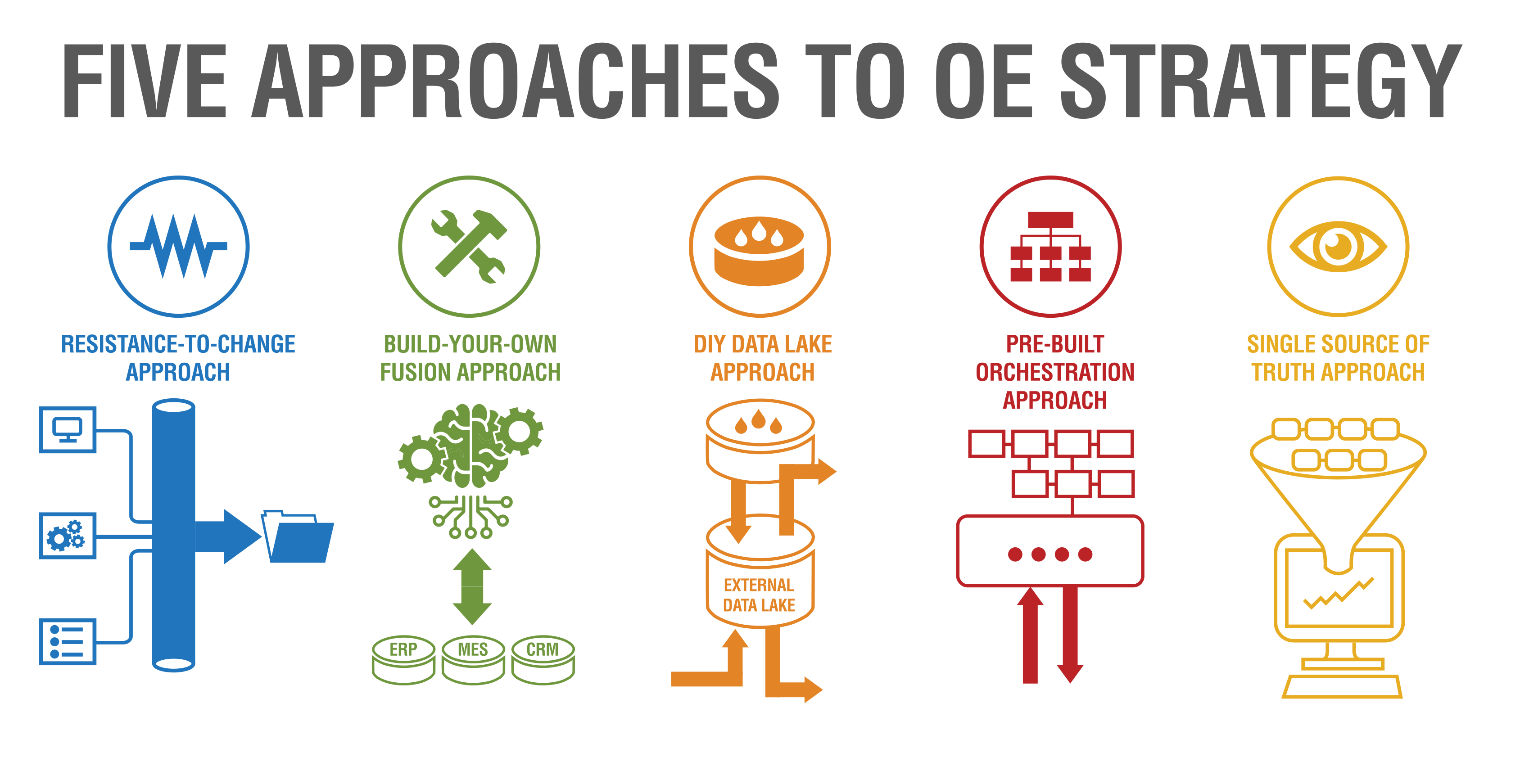**
When it comes to developing, implementing, and maintaining an OE strategy, there are five possible solutions:
1. *Resistance-to-Change Approach* – stay with what you have, understanding the risks of a historian-centric architecture with a taxonomy that can contain attributes to other applications and systems.
2. *Build-Your-Own Fusion Approac*h – layer a knowledge graph-based data architecture over existing systems to create one unified data architecture.
3. *DIY Data Lake Approach* – export data from various applications and systems into an external database, then build additional applications to query and analyze data.
4. *Pre-Built Orchestration Approach* – layer a pre-built ontology and workflow orchestration software over existing applications, driving the connectivity and knowledge graph development to the desired systems.
5. *Single Source of Truth Approach* – rip and replace existing systems with a new, integrated, interoperable system designed to address 90+% of workflows; this would require adopting a new system either wholesale or in phases.
##### **Benefits & Challenges**
By keeping your existing systems as they are or layering a knowledge graph-based data architecture to create a unified structure, you aren’t solving the problem. You’re actually creating a costly, time-consuming, customized solution that is difficult to support and doesn’t drive workflows that make decisions and execute activities.
Building your own data lake is a popular solution among internal IT teams, but it also falls short. External databases are flat, so multi-dimensional relationships are lost or must be rebuilt. Most systems provide better data organization than a plain aggregated SQL database and feature third-party AI analytics, but don’t contain a native graph model. These approaches take a multi-dimensional system and turn it into a flat, aggregated spaghetti system that still requires someone to build relationships.
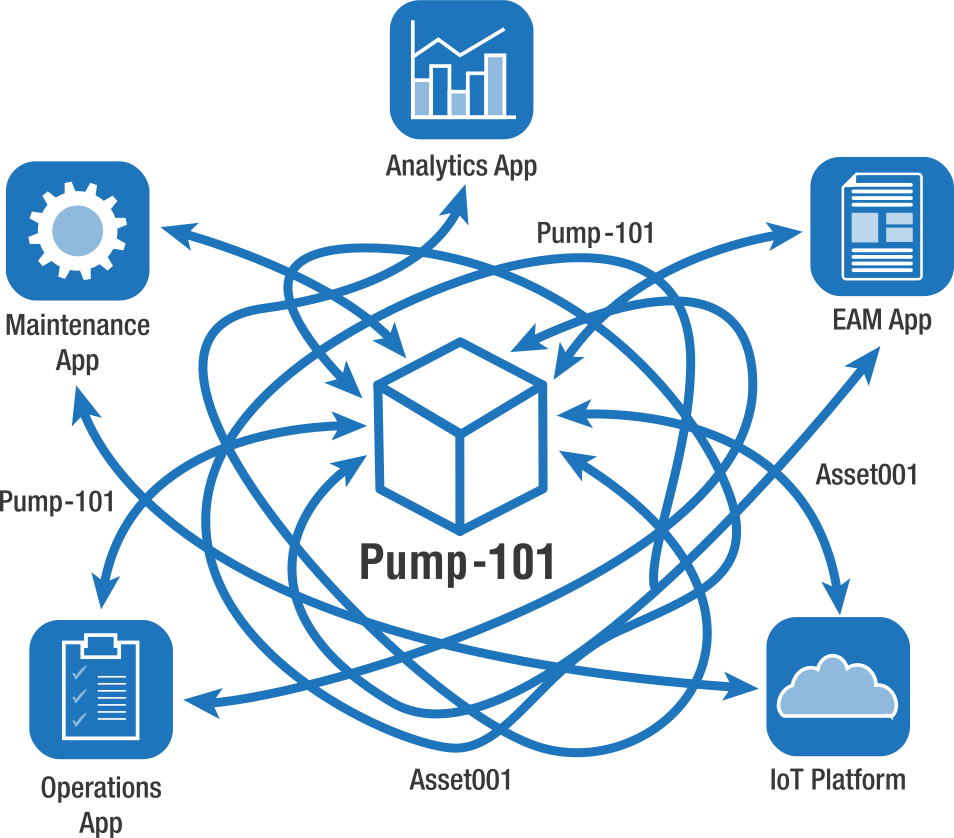
*Figure 1 – Aggregated Spaghetti System*
Aggregated spaghetti systems are significantly more powerful than standard data integration, but still create multiple barriers when attempting to execute desired processes:
- *Semantic Atrophy* – Source systems contain embedded business logic, constraints, and hierarchical relationships. When you flatten this data, you are essentially stripping away the **data's contextual DNA** to fit a rigid row-and-column format. By the time the graph model is applied, you aren't mapping the original architecture; you are mapping a simplified replication of it.
- *Syntactic Interoperability* – Two systems can exchange data records but fail to automatically interpret the meaning of data. You can identify that two things are connected but cannot inherently understand the *nature* or *logic* of the connection without manual interpretation.
- *Latency and Point-in-Time Fragility* – Interoperability in modern industrial or enterprise environments often requires real-time orchestration. If a change occurs in the source architecture, the flattening logic must be manually updated before the graph model can reflect it. This creates a brittle architecture that lags the operational reality.
- *Hidden Relationships* – Aggregation only looks at data within defined buckets, while interoperable systems can reveal how a delay in System A might affect the safety integrity of System B, even if those systems never directly communicate.
- *Multi-Dimensional Context* – Aggregation provides a summary, which can lead to the loss of nuance, whereas an interoperable model provides context.
While pre-built orchestration can solve many challenges, the best approach identified by Operational Sustainability is the wholesale or phased replacement of existing systems with a unified architecture, such as OESuite®. Organizations can start anywhere with OESuite® and adopt the architecture to address all areas of workforce, process safety, assets, operations, compliance, and operational risk in the ways that best suit their OE strategy.
##### **Why Integration and Interoperability Are So Important**
Integration and interoperability are the keys to improved decision-making and faster execution. Today’s facilities are highly automated in both control and production performance. Much of production performance analysis can also be automated industrial AI and advanced analytics platforms. But once a performance problem is predicted or detected, the associated analysis, decision-making, and problem resolution remain largely manual. Decision-making often must escalate through multiple levels before a decision is made and action is taken. This gap, delay, or lag in taking decisive action is costly and directly measurable. The time to act is very real.
For example, if the reliability system predicts an impending failure of Pump-101A’s seal, how long does it take for the resolution action to take place, and how many people are involved in the decision-making and resolution loop? For well-understood failure modes in equipment and devices, the workflow logic can be largely automated. But this requires a data architecture with ontological relationships to drive the logic. The advantage goes to those who not only build and orchestrate workflows but also have pre-built solutions and can incorporate the user’s subject-matter expertise, best practices, and industry standards.
Solutions that drive outcomes are what count.
##### **Summary**
Companies must recognize that re-architecting to a unified architecture is the only strategic option, the same decision one would make for a greenfield facility. It is the only one of the five solution options that helps you achieve and sustain OE and future-proofs your data architecture as AI continues to become a more powerful lens. It means building a strong foundation with a solid governance structure to avoid the intensive human effort and the likely deviations from the discipline required to sustain OE. Finally, recognizing the value of a built-for-purpose OE solution with all the right interoperability built in helps you avoid having to reconstruct the technical debt that continues to hold you back.
« [Previous](https://blog.drivingoe.com/an-operational-excellence-opex-strategy-requires-an-enterprise-architecture-part-2)
[Back to News & Articles](https://blog.drivingoe.com)
### Topics of Interest
- [Asset Strategy / Asset Performance Management (9)](https://blog.drivingoe.com/tag/asset-performance-management)
- [Compliance Management (5)](https://blog.drivingoe.com/tag/compliance-management)
- [Conduct of Operations (15)](https://blog.drivingoe.com/tag/conduct-of-operations)
- [Cultural Safety (4)](https://blog.drivingoe.com/tag/cultural-safety)
- [EHS / Sustainability (3)](https://blog.drivingoe.com/tag/ehs-sustainability)
- [Enterprise Loss Prevention (9)](https://blog.drivingoe.com/tag/enterprise-loss-prevention)
- [Management of Change (8)](https://blog.drivingoe.com/tag/moc)
- [Mechanical Integrity (3)](https://blog.drivingoe.com/tag/mechanical-integrity)
- [Mobile Applications (5)](https://blog.drivingoe.com/tag/mobile-applications)
- [Operational Excellence (14)](https://blog.drivingoe.com/tag/operational-excellence)
- [Operational Readiness (10)](https://blog.drivingoe.com/tag/operational-readiness)
- [Operational Risk Management (18)](https://blog.drivingoe.com/tag/operational-risk-management)
- [Organizational Performance (11)](https://blog.drivingoe.com/tag/organizational-performance)
- [Press Releases (7)](https://blog.drivingoe.com/tag/press-releases)
- [Process Safety / RMP (23)](https://blog.drivingoe.com/tag/process-safety-rmp)
- [Production / Value (4)](https://blog.drivingoe.com/tag/production-value)
- [Workforce Competency / Connected Workforce (11)](https://blog.drivingoe.com/tag/workforce-competency-connected-workforce)
Operational Sustainability, LLC
16225 Park Ten Place Drive
Suite 800
Houston, TX 77084
Phone: [(713) 355-2900](tel:+1-713-355-2900)
[Contact Us](https://drivingoe.com/connect-with-os/contact-os/)

© 2025 Operational Sustainability, LLC. All rights reserved.
[Privacy Policy](https://drivingoe.com/privacy-policy) | [Terms of Use](https://drivingoe.com/terms-of-use)
```json
{
"@context" : "https://schema.org",
"@type" : "NewsArticle",
"author" : [ {
"@type" : "Person",
"name" : "Operational Sustainability",
"url" : "https://blog.drivingoe.com/author/operational-sustainability"
} ],
"dateModified" : "2026-10-05T15:29:56",
"datePublished" : "2026-09-01T18:19:12",
"headline" : "An Operational Excellence (OPEX) Strategy Requires an Enterprise Architecture: Part 3",
"image" : [ "https://7432105.fs1.hubspotusercontent-na1.net/hubfs/7432105/undefined-2.png" ]
}
```
```json
{
"@context" : "https://schema.org",
"@type" : "BlogPosting",
"author" : {
"@type" : "Person",
"name" : "Operational Sustainability",
"url" : "https://blog.drivingoe.com/author/operational-sustainability"
},
"dateModified" : "2026-10-05T15:29:56.225Z",
"datePublished" : "2026-09-01T18:19:12.000Z",
"headline" : "An Operational Excellence (OPEX) Strategy Requires an Enterprise Architecture: Part 3",
"mainEntityOfPage" : {
"@id" : "https://blog.drivingoe.com/an-operational-excellence-opex-strategy-requires-an-enterprise-architecture-part-3",
"@type" : "WebPage"
},
"publisher" : {
"@type" : "Organization",
"logo" : {
"@type" : "ImageObject",
"url" : "https://blog.drivingoe.com/hubfs/OS-Stacked-300x300-1.png"
},
"name" : "Operational Sustainability, LLC®"
}
}
```